Gregorio Orlando

Portfolio

Gregorio Orlando

Robotics researcher and engineer, happiest in the seams between hardware, perception and software.

I grew up in Milan taking things apart. I am finishing a BSc in Computer Science and Artificial Intelligence at IE University in Madrid, and have worked in the university's Robotics and AI Lab since August 2023, where I also keep the 3D printers alive.

What draws me to robotics is that it refuses to let you specialise too early. The interesting problems live between the mechanism, the perception and the software, and you cannot reason about a seam from one side only. I also care about what comes after the demo: a robot that works in the lab is a prototype, a robot that measurably helps someone is a result.

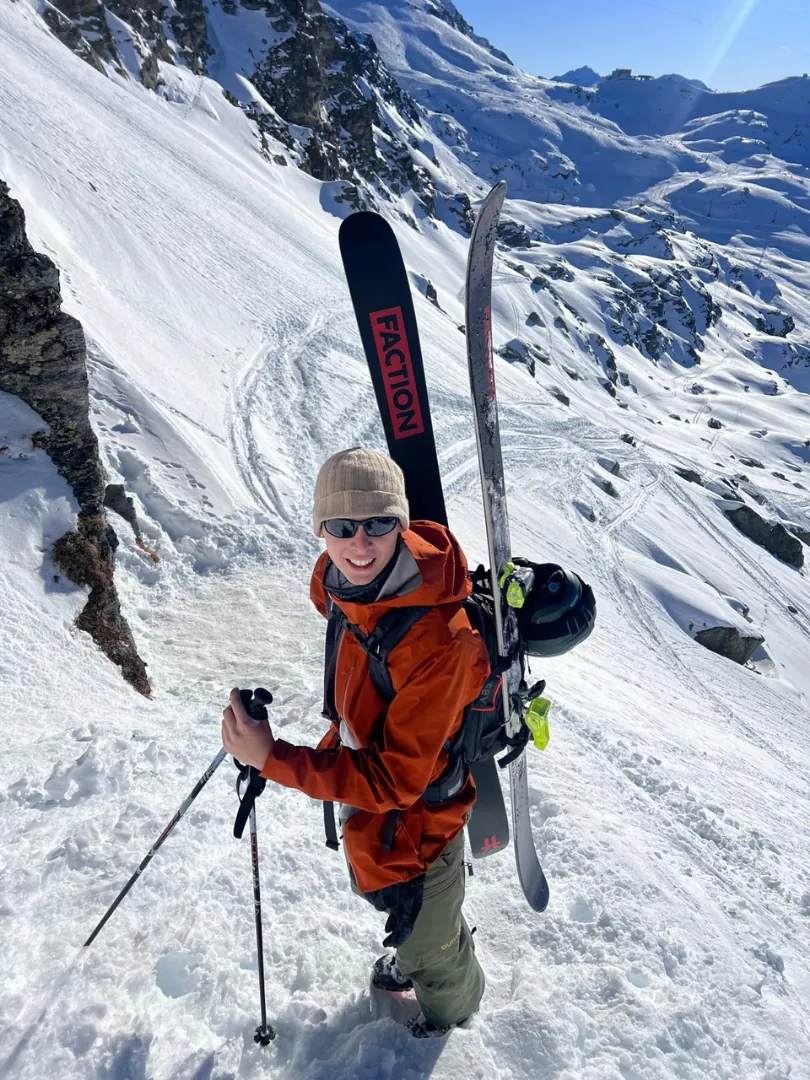
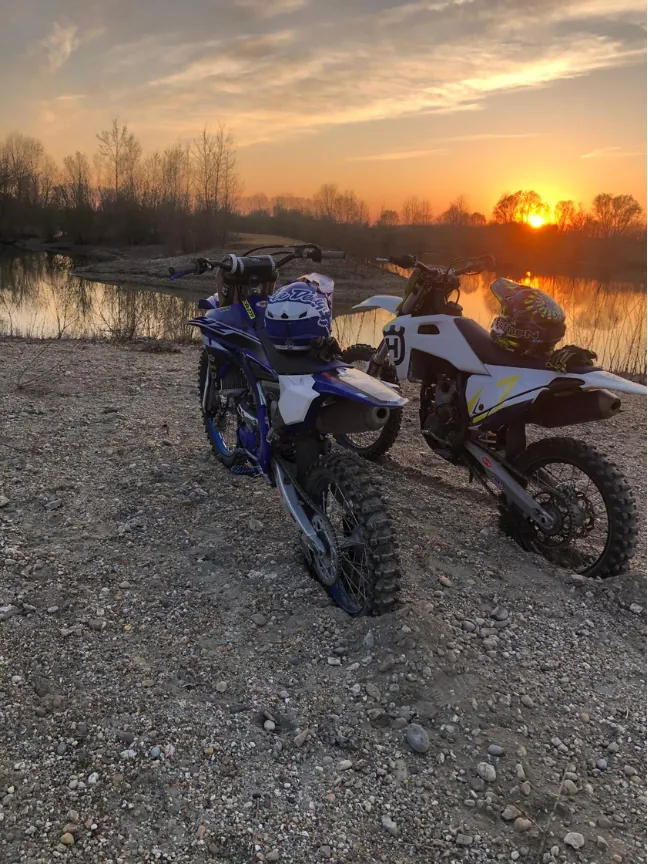
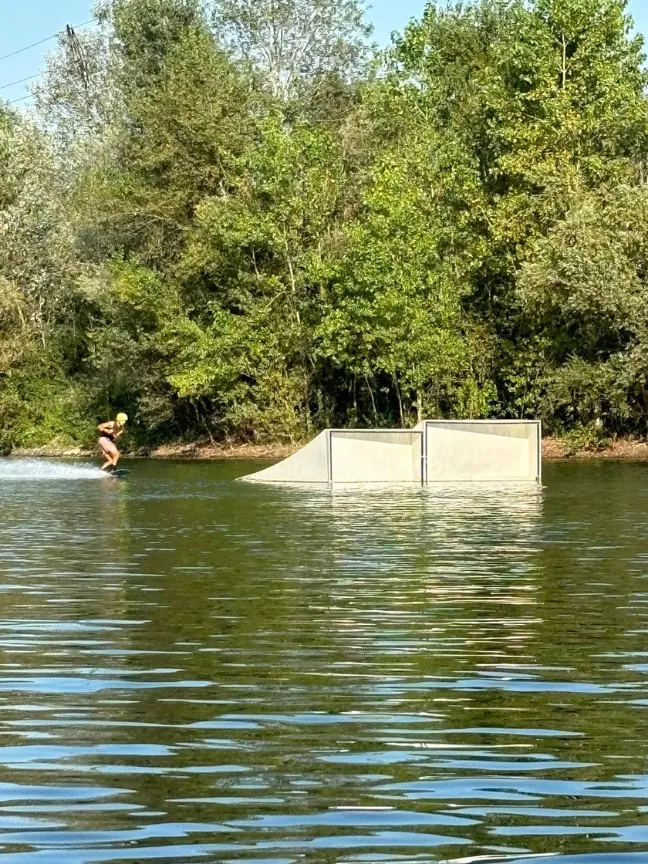
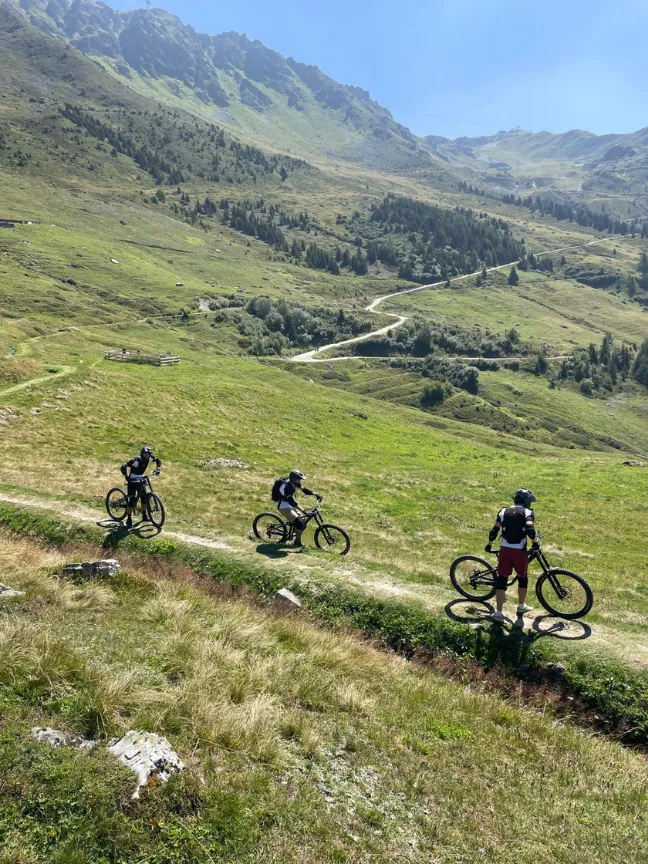
Outside the lab I ski off-piste, ride motocross and downhill, and wakeboard. Since 2010 I have helped run charity events with ITACA in Milan for people with mental disabilities.

Next: a master's in robotics or computer science, deeper into perception, state estimation and robot learning. Italian (native) · English (fluent) · Spanish and French (intermediate).

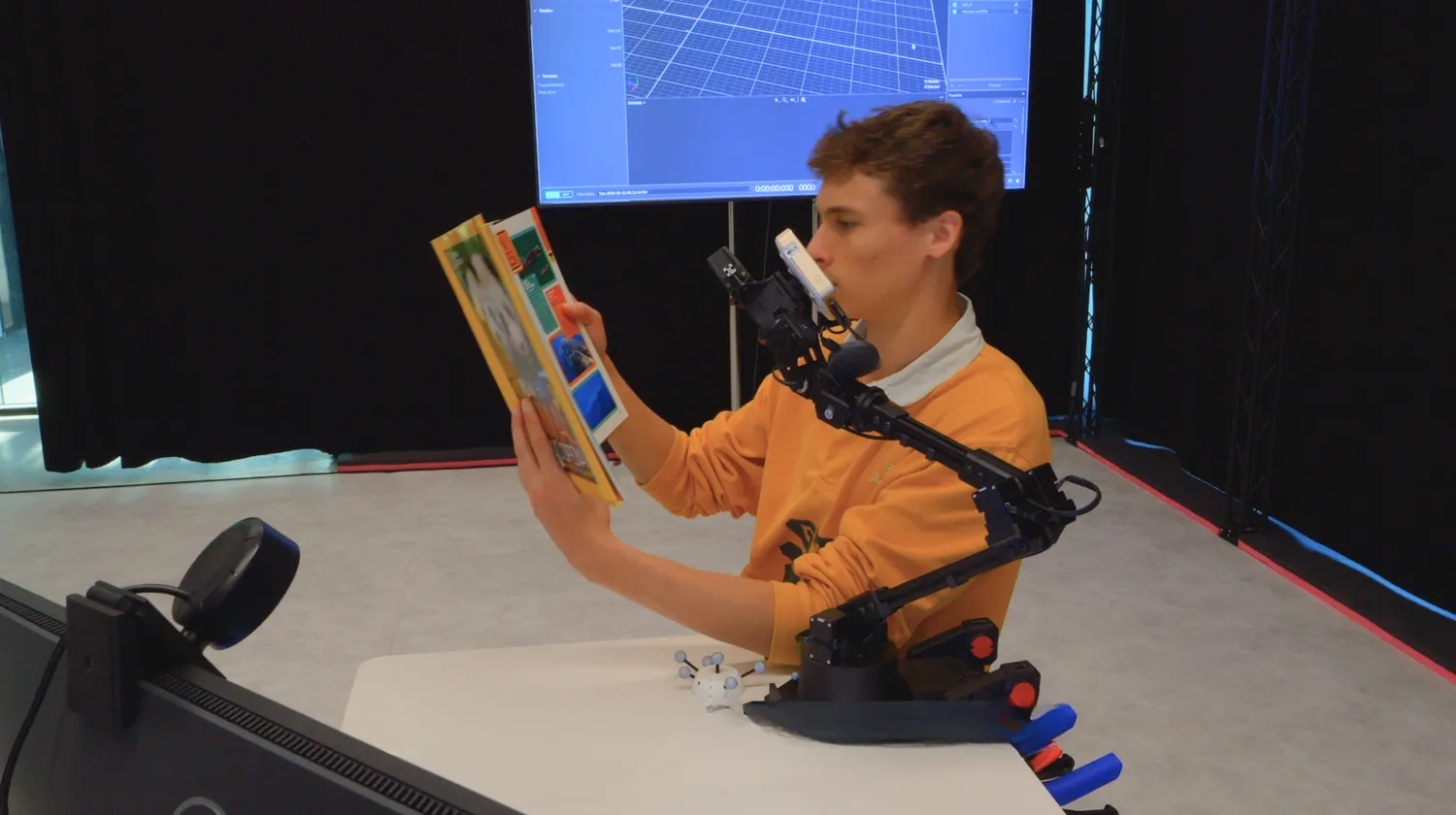
A person working at a desk while the AIfred robot arm holds a projector over their work.
AIfred, a robot arm that puts AI guidance onto the page you are working on.
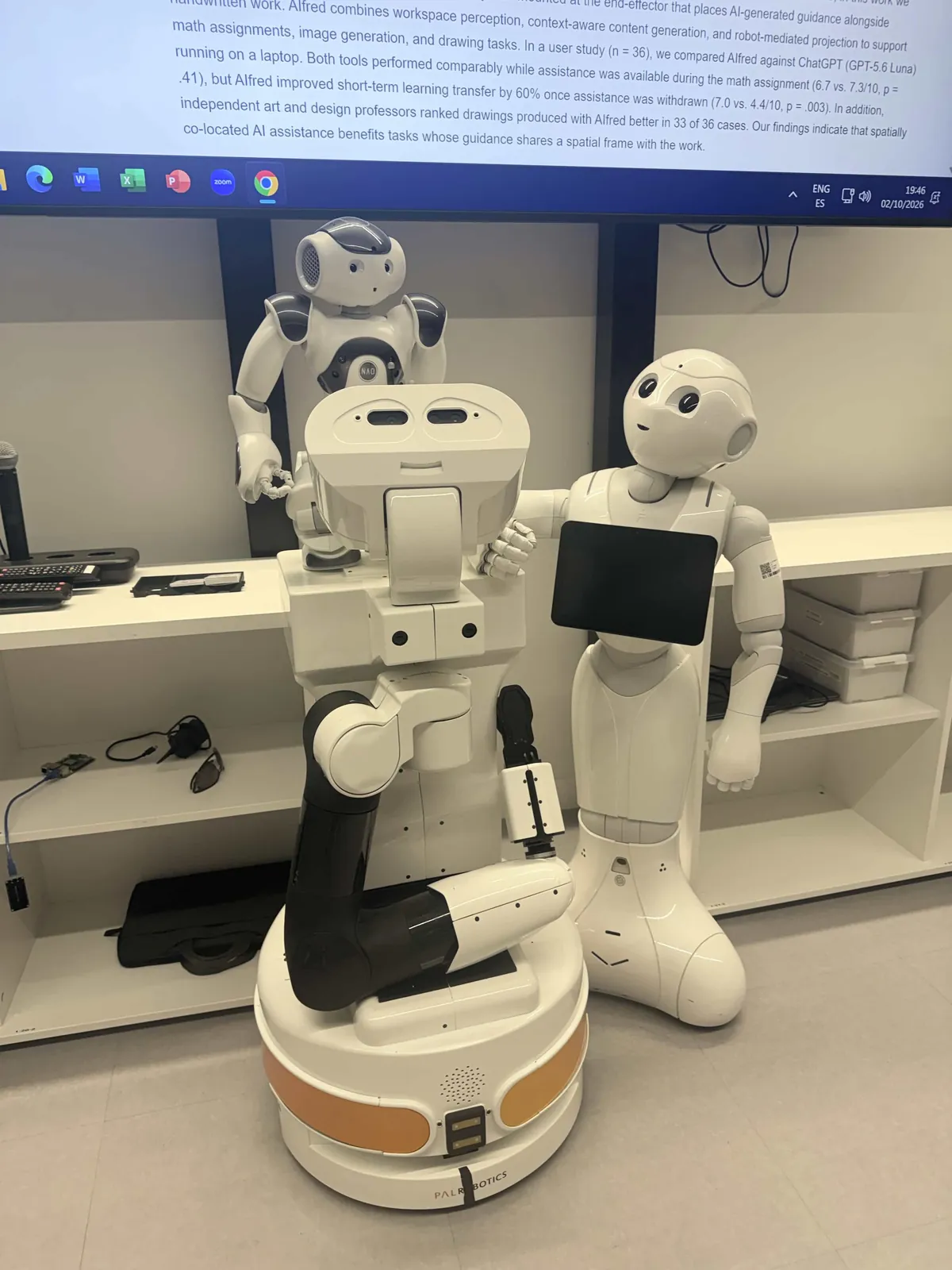
Robots in the IE Robotics and AI Lab, including a Pepper and a NAO humanoid, with the AIfred paper on screen behind.
The lab, most days.

Projects

01 CyPhy Life · 2025 - present

AIfred

A robot arm that projects AI help onto your desk
  • ROS Noetic
  • WidowX 250s
  • OptiTrack
  • Multimodal AI
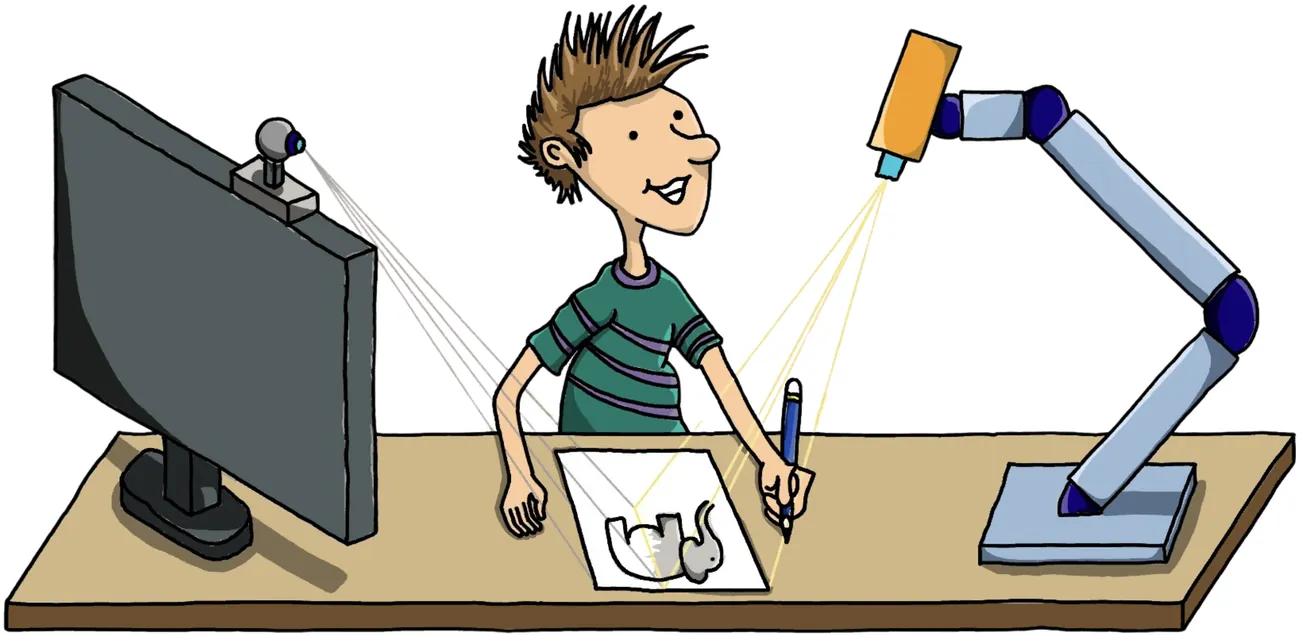
Illustration of the idea: a person draws at a desk while a robot arm projects guidance onto the paper and a camera on the monitor watches the work.

Abstract— Desk-based learning and creative activities benefit from handwritten engagement. However, current generative AI tools deliver guidance through a separate screen, creating a gap between where users think and where assistance appears. To address this, in this work we design AIfred, a desk-based robotic arm with a projector mounted at the end-effector that places AI-generated guidance alongside handwritten work. AIfred combines workspace perception, context-aware content generation, and robot-mediated projection to support math- assignments, image-generation, and drawing tasks. In a user study (n = 36), we compared AIfred against ChatGPT (GPT-5.6 Luna) running on a laptop. Both tools performed comparably while assistance was available during math assignment (6.7 vs. 7.3/10, p = .41), but AIfred improved short-term learning transfer by 60% once assistance was withdrawn (7.0 vs. 4.4/10, p = .003). In addition, independent art and design professors ranked drawings produced with AIfred better in 33 of 36 cases. Our findings indicate that spatially co-located AI assistance benefits tasks whose guidance shares a spatial frame with the work.

Submitted to ICRA 2027, under review.
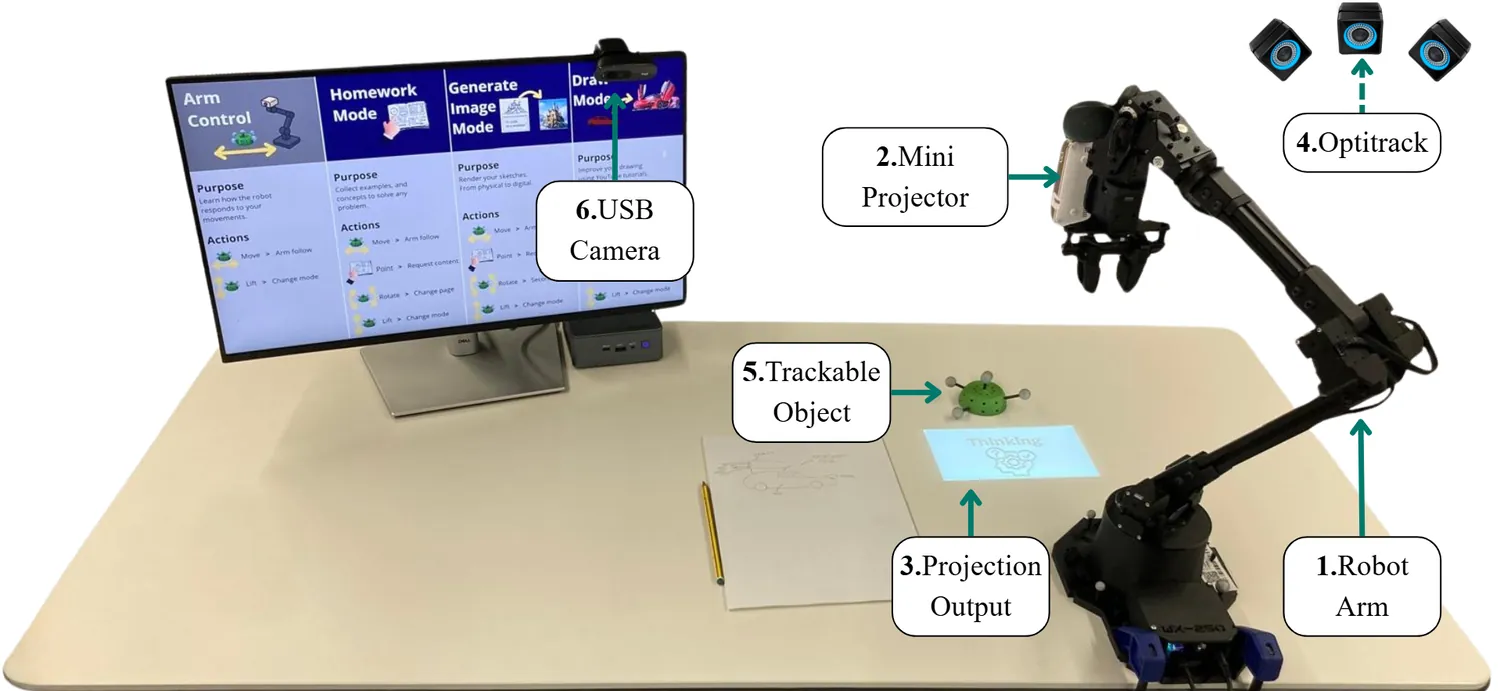
The AIfred station labelled with its parts: robot arm, mini projector, projection output, OptiTrack cameras, trackable object and USB camera.
System overview.
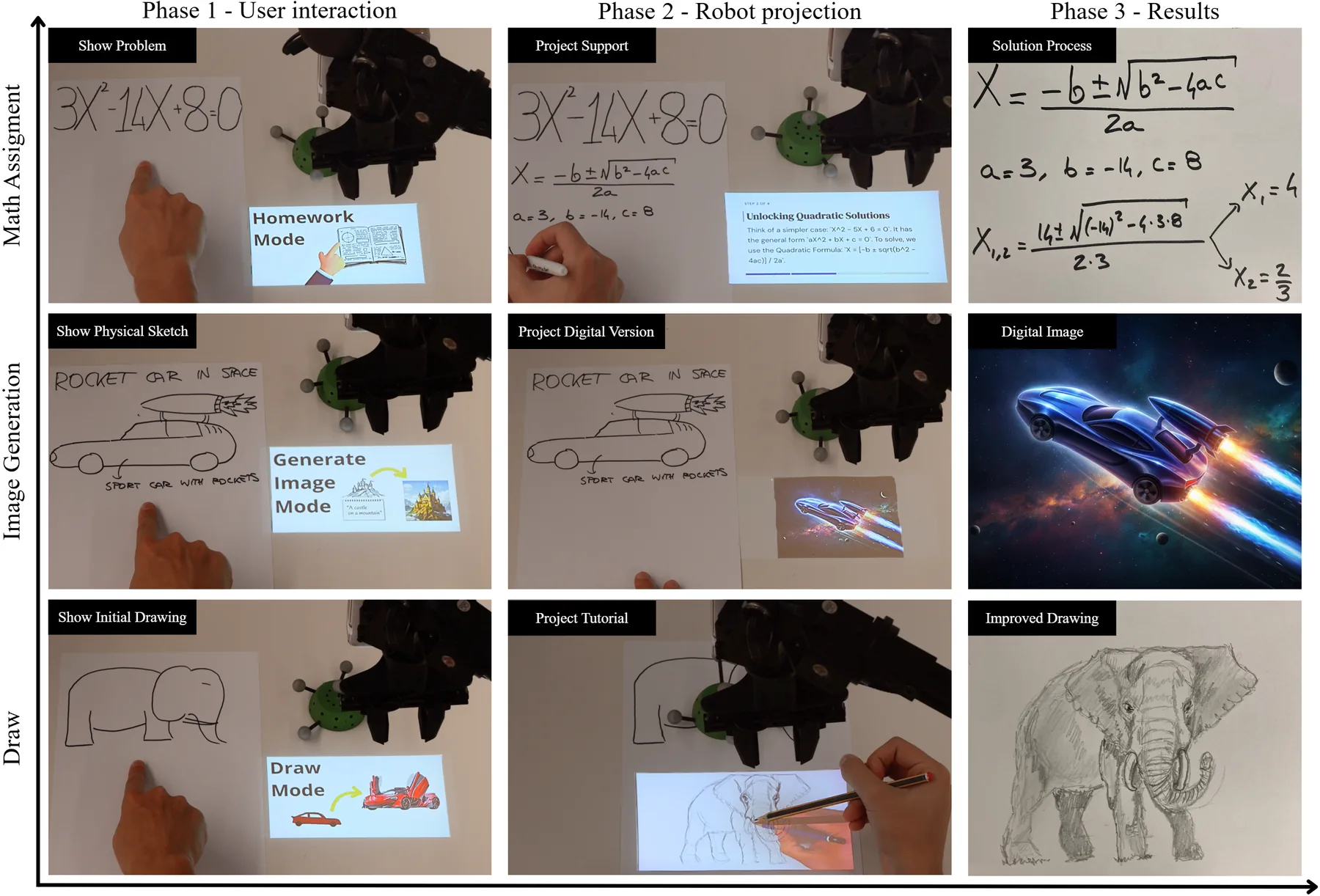
Nine-panel figure: for maths homework, image generation and drawing, it shows the user's interaction, the robot's projection, and the resulting work.
Three modes, three phases each: what the user does, what the robot projects, what comes out.
Solving Math: the method, projected, not the answer.
Drawing: construction lines on the page; every mark still the user's.
Image Generation: a pencil sketch comes back rendered.
7.0 vs 4.4 Score on a fresh equation once help was withdrawn of 10 · p = .003
33 / 36 Drawings ranked first by independent art professors Kendall's W = .86
1 vs 63 Switches between the work and the assistance 98% fewer
4.5 vs 3.4 Felt the system supported their own learning of 5 · p < .001

The study compares two whole systems, not single design features. Embodiment, projection and the style of the guidance.
02 CyPhy Life · 2023 - present

Botzo

An open-source robot dog, rebuildable for under €500

  • Inverse kinematics
  • Gait planning
  • IMU control
  • Isaac Lab / RL
  • ROS 2
  • Fusion 360

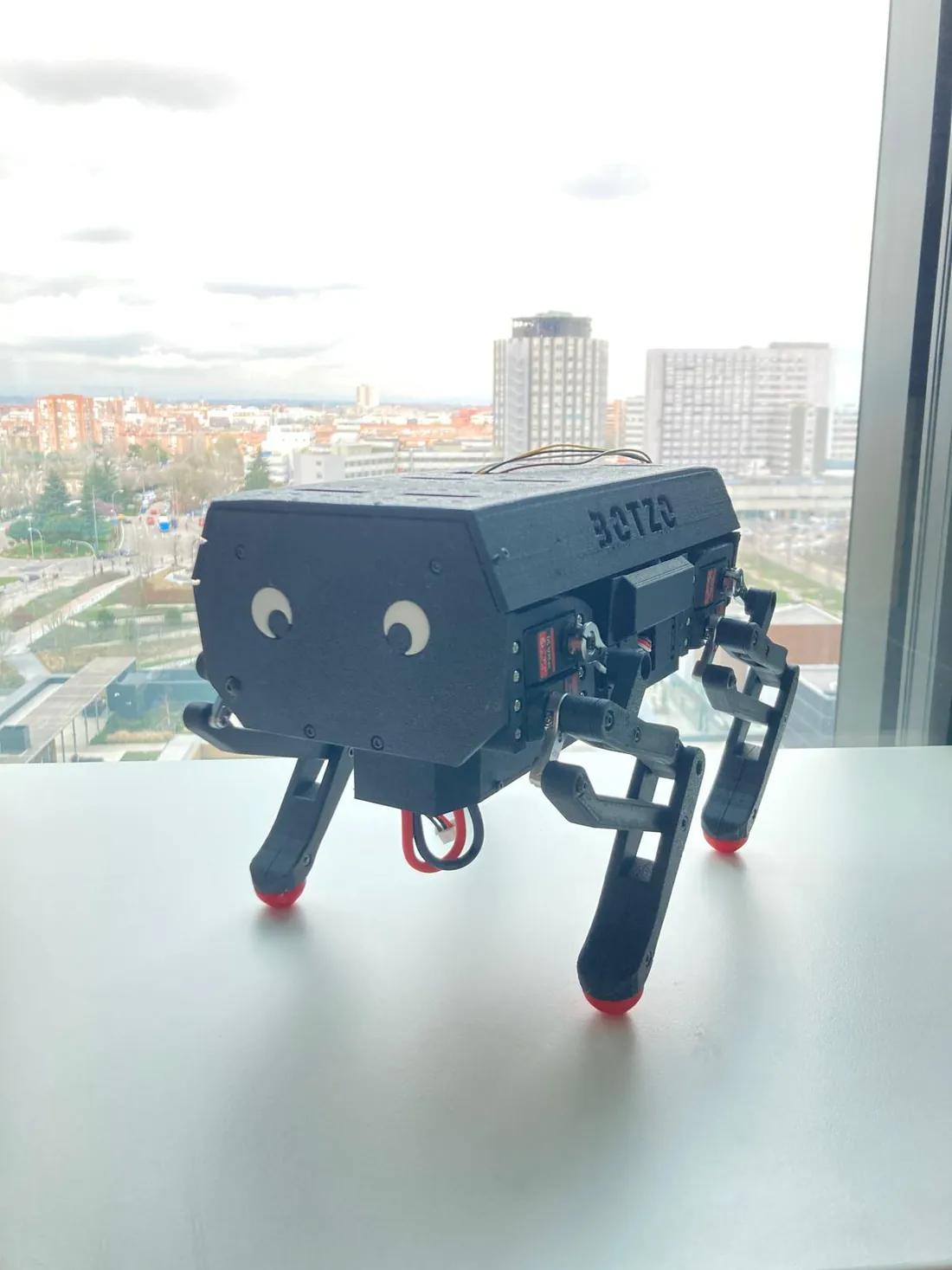
Quadrupeds are easy with harmonic drives and torque sensing, and hard with hobby servos. Botzo is the hard version, on purpose: printed parts, 25 kg servos and a Raspberry Pi, documented so other people can rebuild it. Our community is already doing so, and the Botzo repo has been forked 4 times, and starred 13 times.

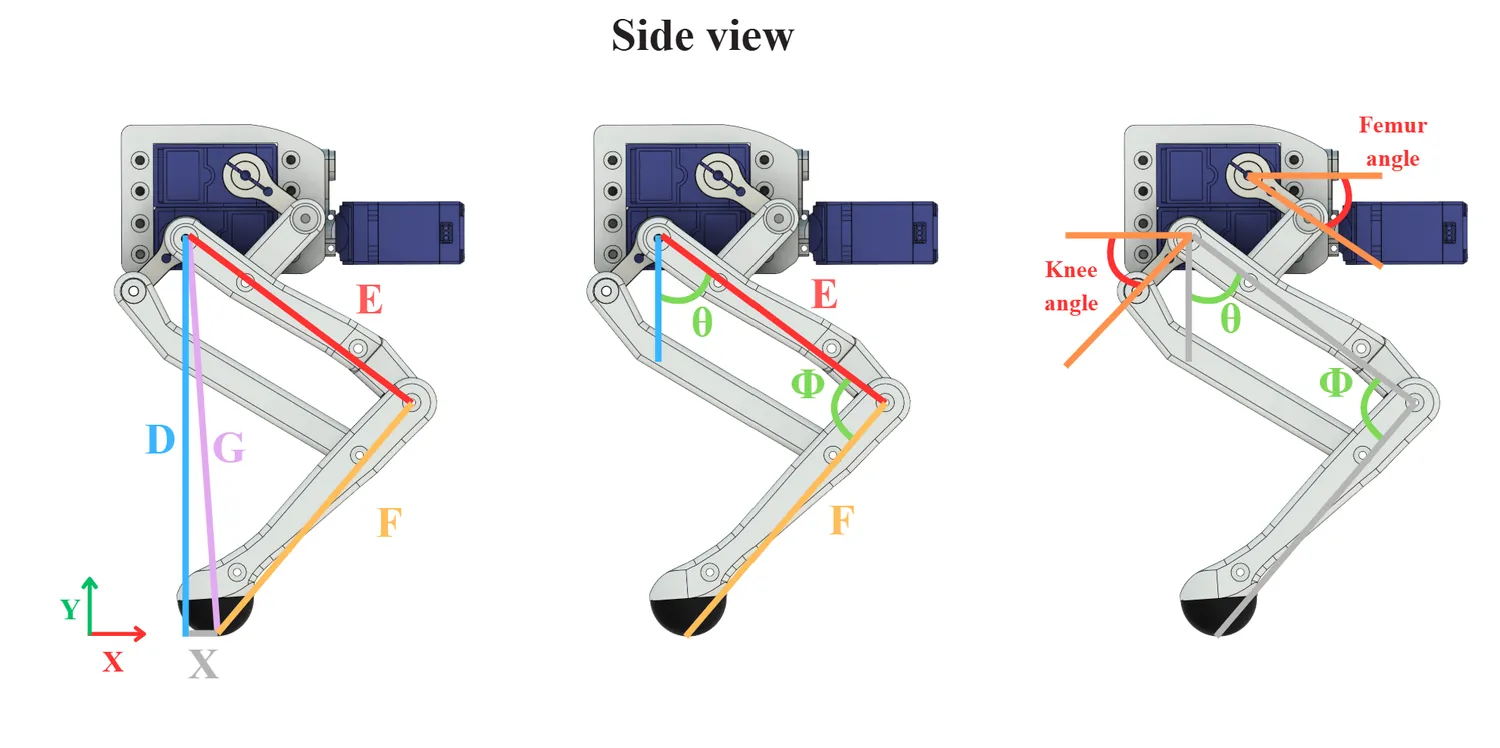
Low-inertia leg geometry, closed-form inverse kinematics, gait planning, and ROS 2 Jazzy orchestration. The current work replaces that hand-tuned gait with a policy trained in NVIDIA Isaac Lab.

The Botzo quadruped robot standing on a ledge, a blue printed body on four legs.
Botzo, assembled.
Walking around campus.
Designed from scratch in CAD. The whole assembly, part by part.
Hand-annotated trigonometry working out the inverse kinematics of a Botzo leg, side view.
The inverse kinematics, worked out by hand.
Isaac Lab work in progress.

03 University of Luxembourg, SnT · Jul - Dec 2025

PolyWall

Turning SLAM maps into geometry a headset can afford

  • SLAM
  • Point clouds
  • Geometry processing
  • Unity
  • VR Summit

A LiDAR SLAM map is millions of triangles: ideal for a robot, hostile to a HoloLens that must also render an application at frame rate. Most of that detail is irrelevant, if the XR scene only needs to know where the walls are, surface roughness is pure cost.

Six months at the SnT Automation & Robotics Group, on the conversion step: extract the planar wall structure, discard the rest, hand Unity something it can draw. 4.27 M triangles to 18,094.

Presented at the VR Summit 2026 in Germany, and used in Human Interaction for Collaborative Semantic SLAM using Extended Reality.

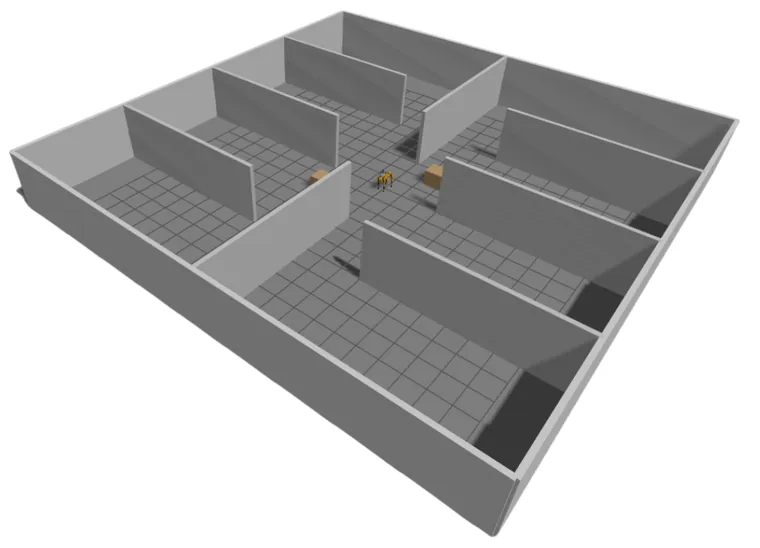
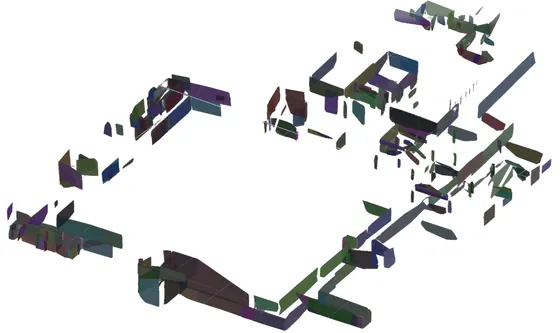
Grey ground-truth model of the test environment's walls.
Ground truth: the environment as it is.
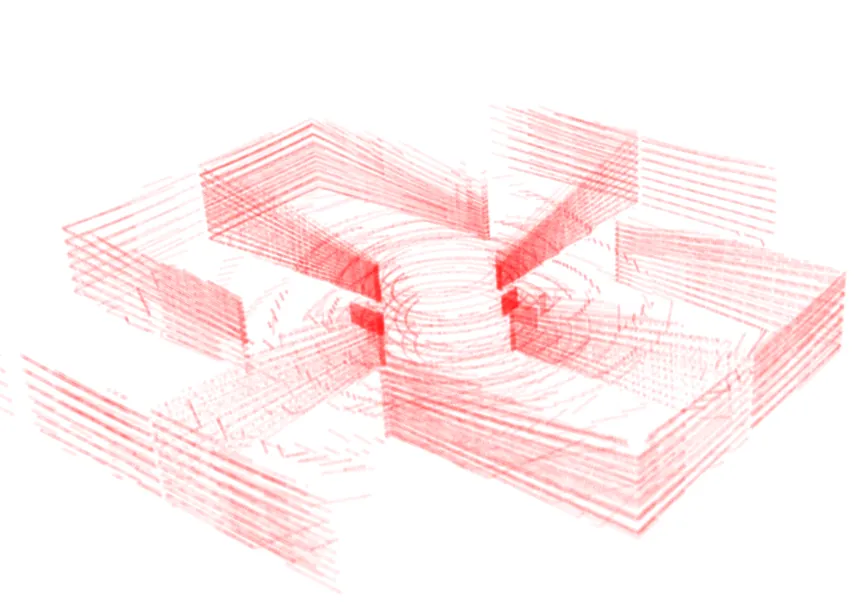
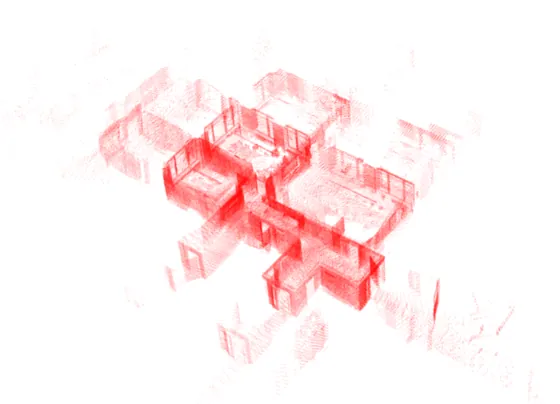
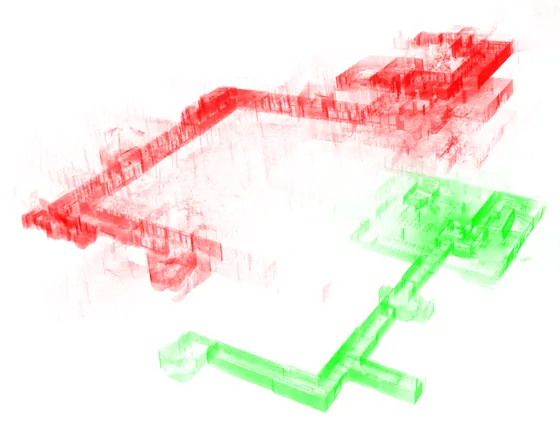
The same floor plan in RViz as a dense red LiDAR point cloud, thick with overlapping points.
Raw point cloud: the LiDAR's PCL in RViz, 4,270,000 triangles.
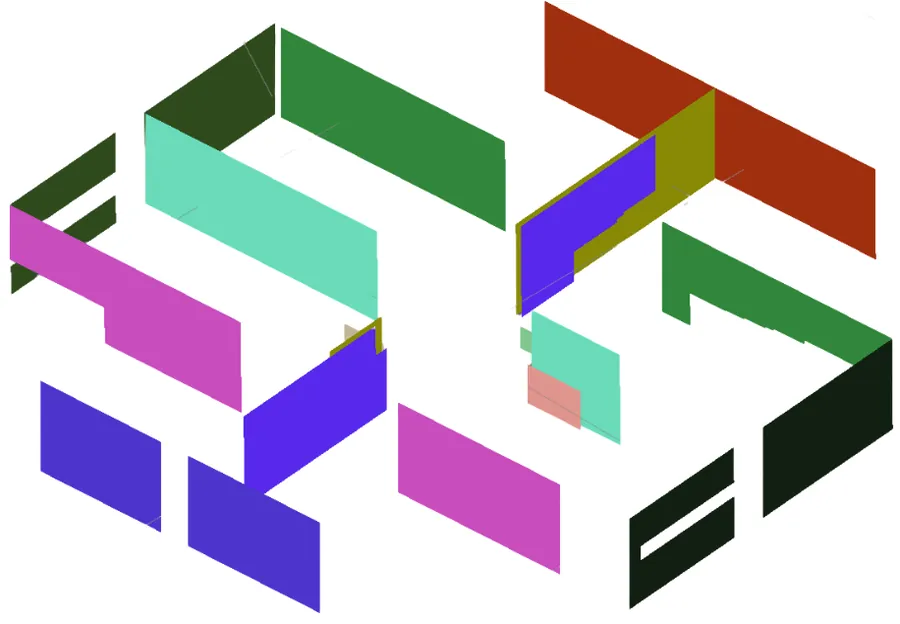
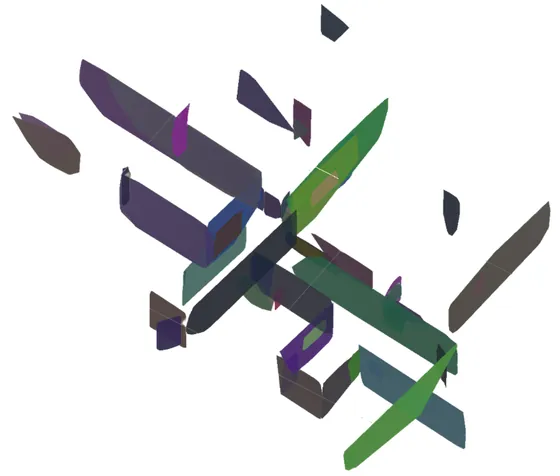
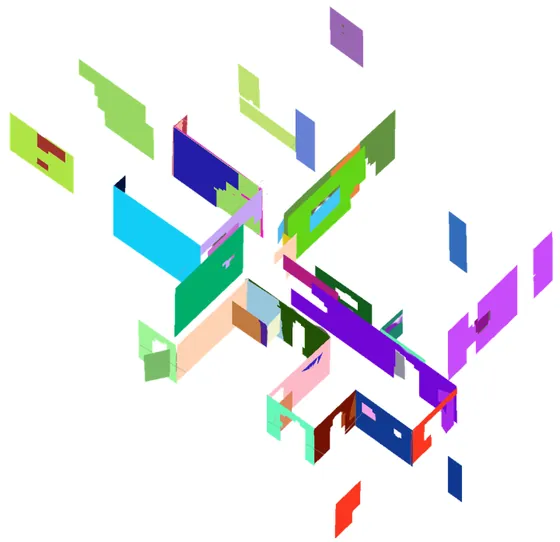
The same floor plan rebuilt as a small set of flat coloured polygons, one per wall.
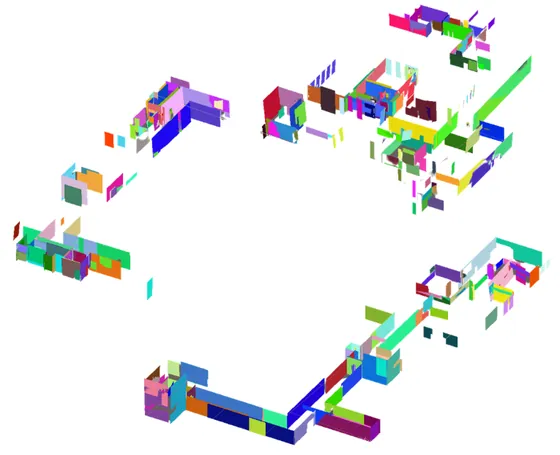
Our compression: bounded planes, 18,094 triangles. The room survives; the noise does not.
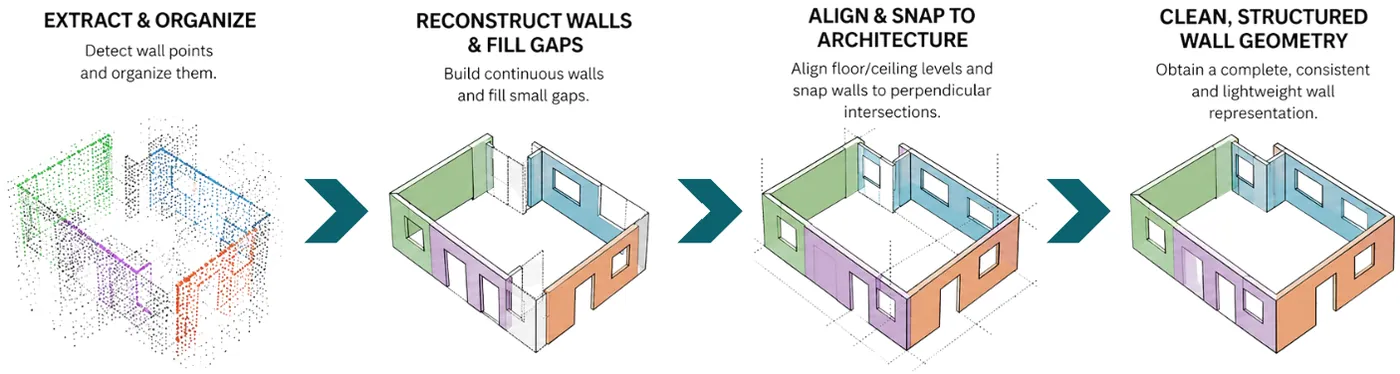
Four-step pipeline: extract and organise wall points, reconstruct walls and fill gaps, align and snap to the architecture, then output clean structured wall geometry.
The pipeline, end to end.

Second environment

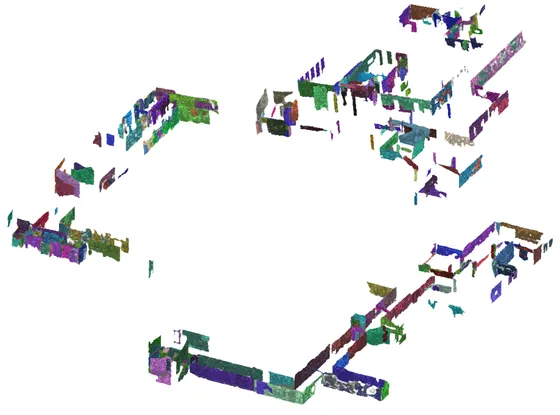
The second environment as a raw LiDAR point cloud.
Raw point cloud
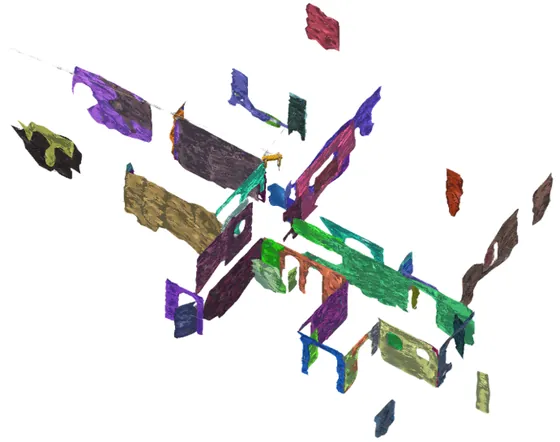
The second environment reconstructed by the convex hull baseline: bloated, overlapping shells.
Convex hull
The second environment reconstructed by the nearest point baseline: ragged, holed surfaces.
Nearest point
The second environment reconstructed by PolyWall: clean bounded planes, one per wall.
PolyWall (ours)

Third environment

The third environment as a raw LiDAR point cloud.
Raw point cloud
The third environment reconstructed by the convex hull baseline: bloated, overlapping shells.
Convex hull
The third environment reconstructed by the nearest point baseline: ragged, holed surfaces.
Nearest point
The third environment reconstructed by PolyWall: clean bounded planes, one per wall.
PolyWall (ours)

04 IE Robotics Club · OSHWDem, A Coruña 2023

Minotauro

A 454-gram combat robot, and an education in what breaks

  • ESP32
  • C++
  • Motor drivers
  • Power electronics
  • Teamwork

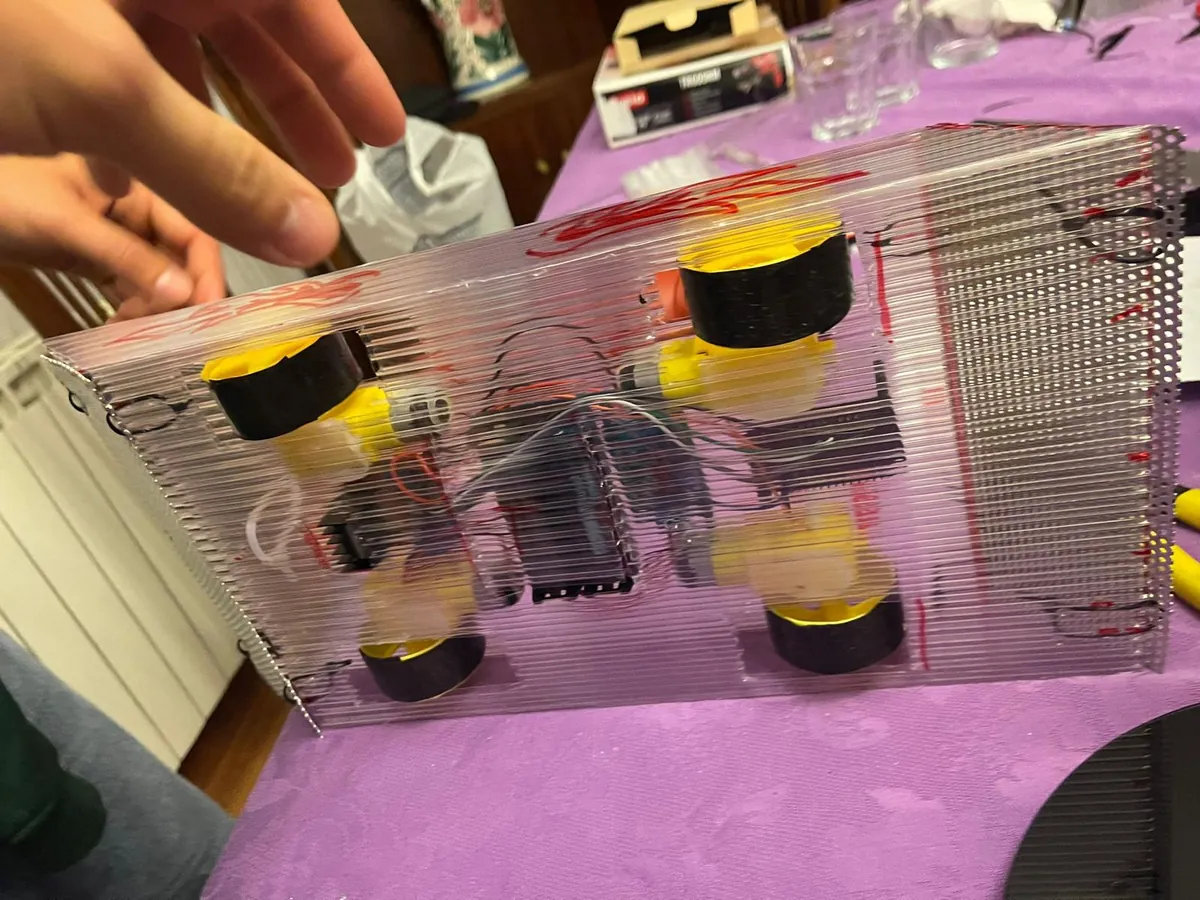
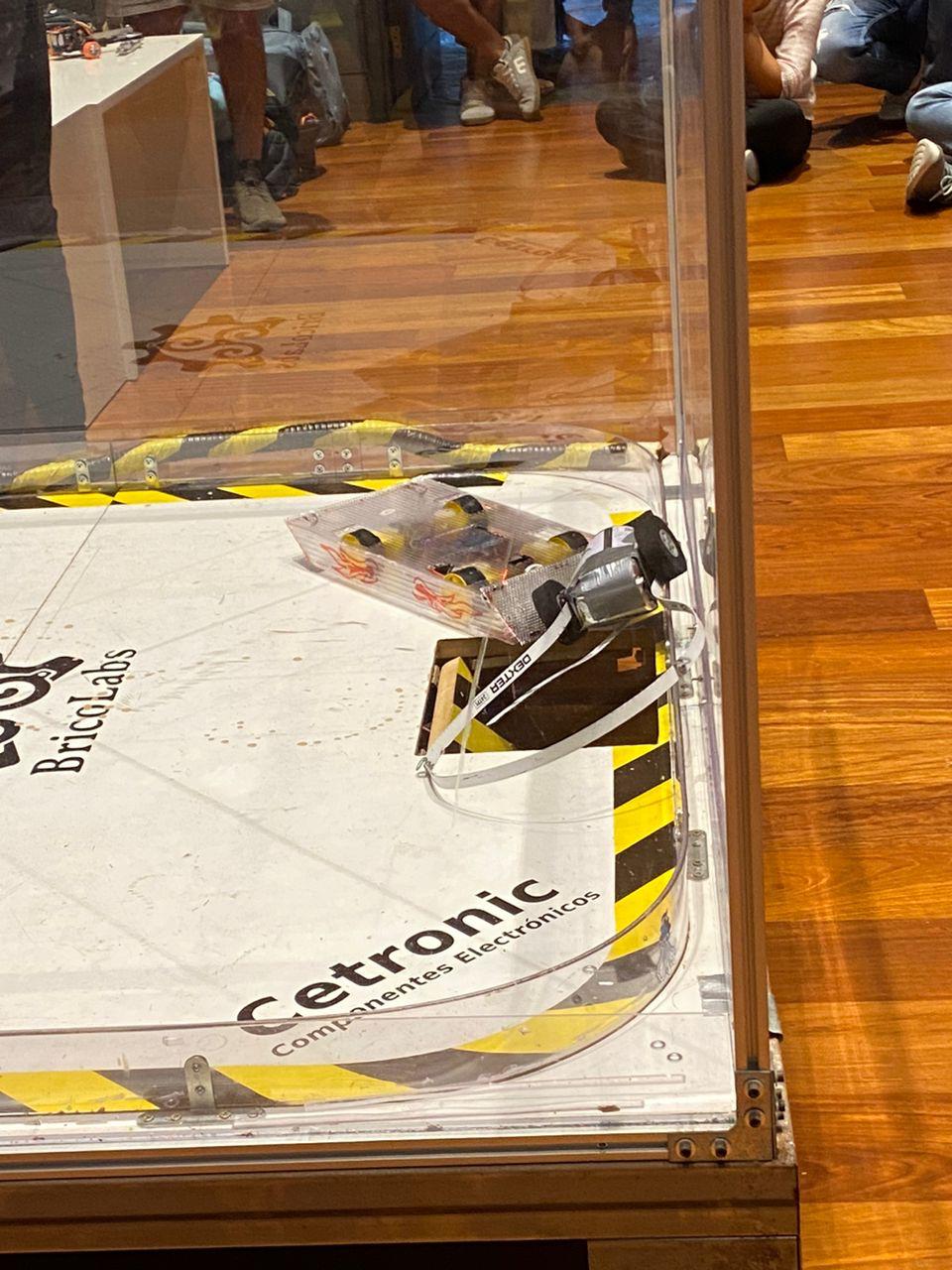
No weapon, by choice: a low polycarbonate wedge on four-wheel drive, symmetric about its horizontal plane so being flipped changes nothing. An ESP32 takes a PS4 controller over Bluetooth and drives four motors through an L293N.

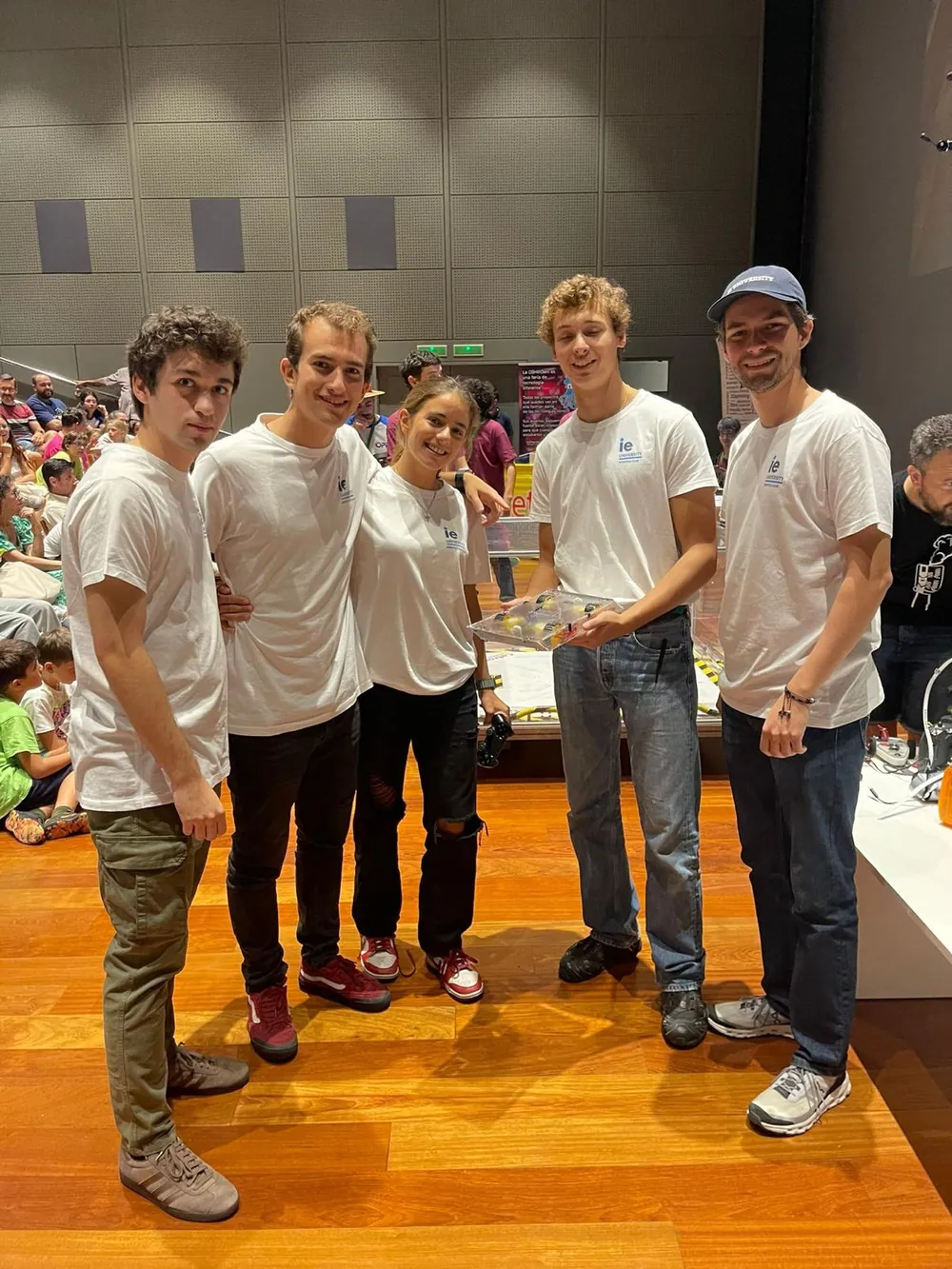
Fourth of eleven on the team's first attempt, out in the semi-final when the chassis cracked. Plastic wheels shattered, the motors could not out-push anyone.

The finished Minotauro robot: a clear polycarbonate shell over four yellow wheels.
Finished, the night before.
Free-for-all.
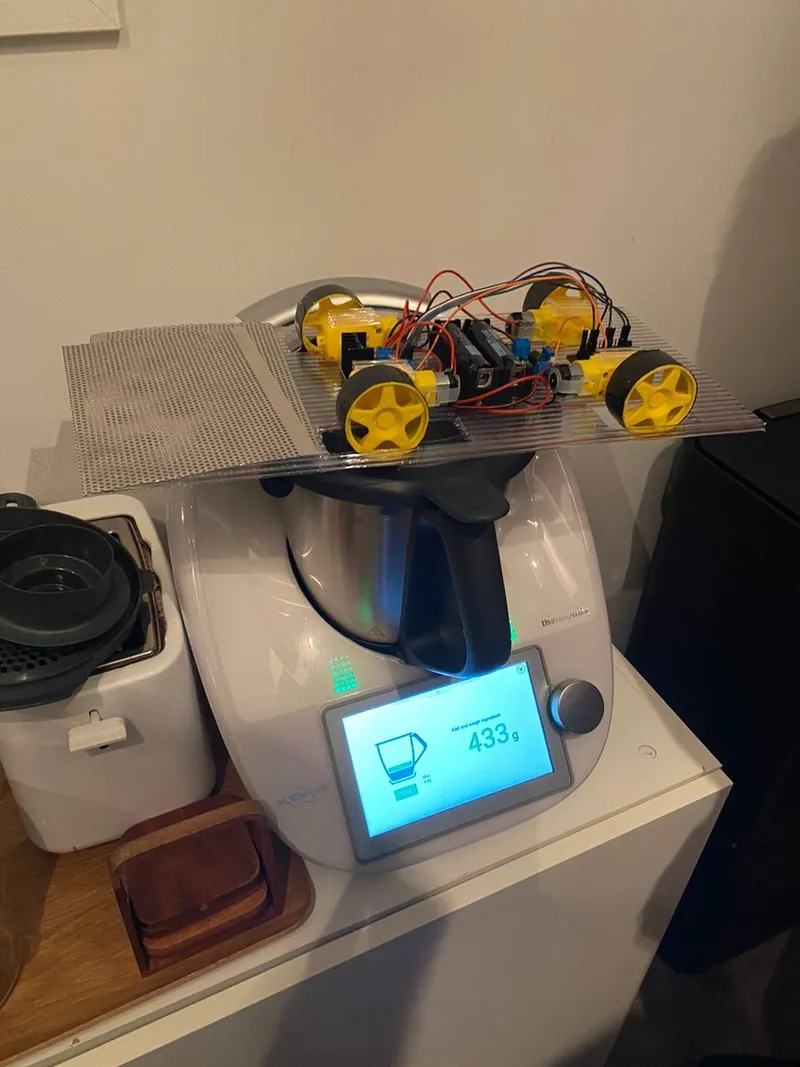
The robot on a kitchen scale reading 453 grams.
Every gram contested.
Hand-painted flame decals on the robot's clear polycarbonate ramp.
First win.
The IE Robotics Club team standing together at the OSHWDem venue.
The team.

Also built

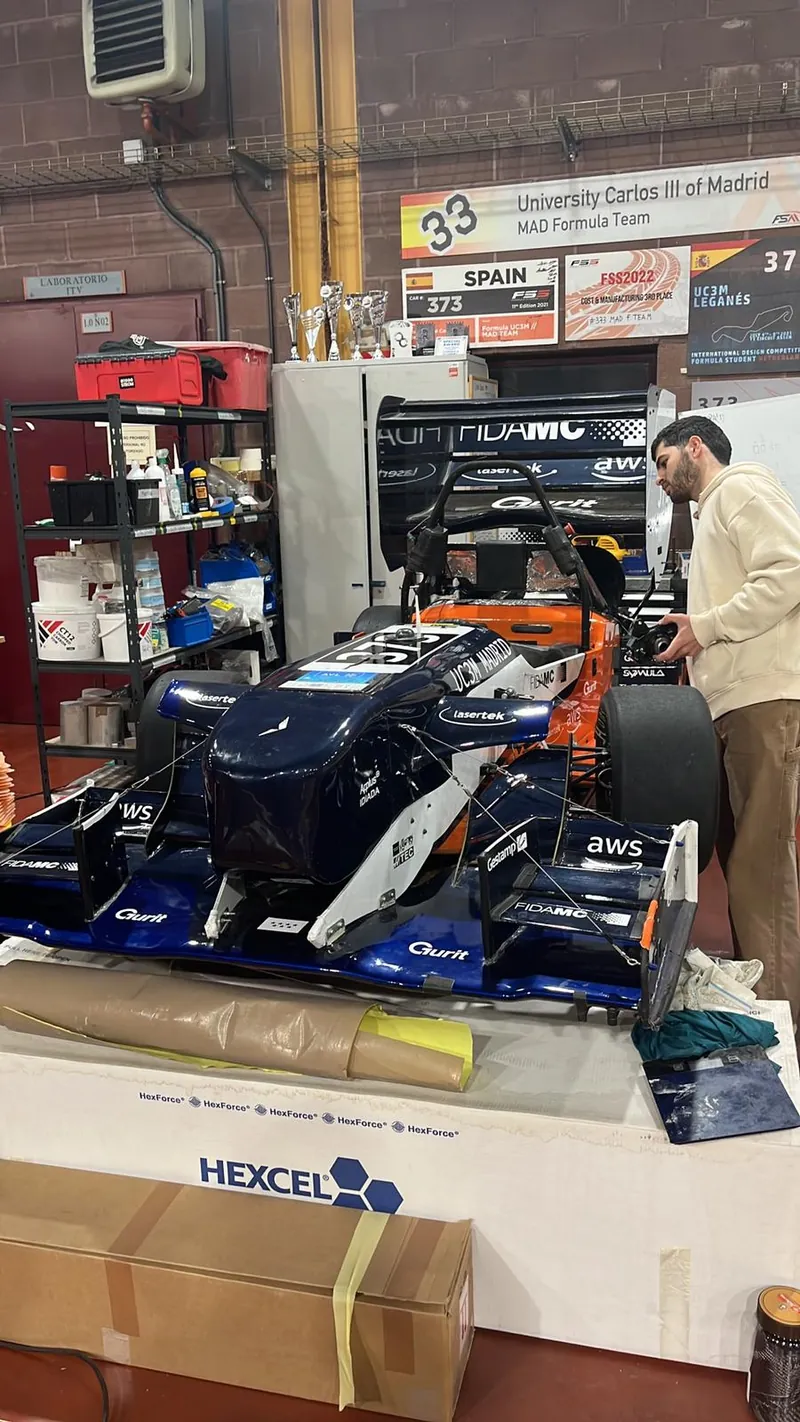
The Formula Student car in the team garage.

Formula Student · UC3M · 2024

Telemetry recorder

A ROS 2 package in C++ that captured every message on the car into both a ROS bag and a spreadsheet, so the team could analyse a run instead of recalling it.

  • ROS 2
  • C++

Side project

Wall-follower car

Holds a set distance from a wall using ultrasonic sensing and a control loop. The cheapest possible lesson in the gap between a sensor reading and a stable system.

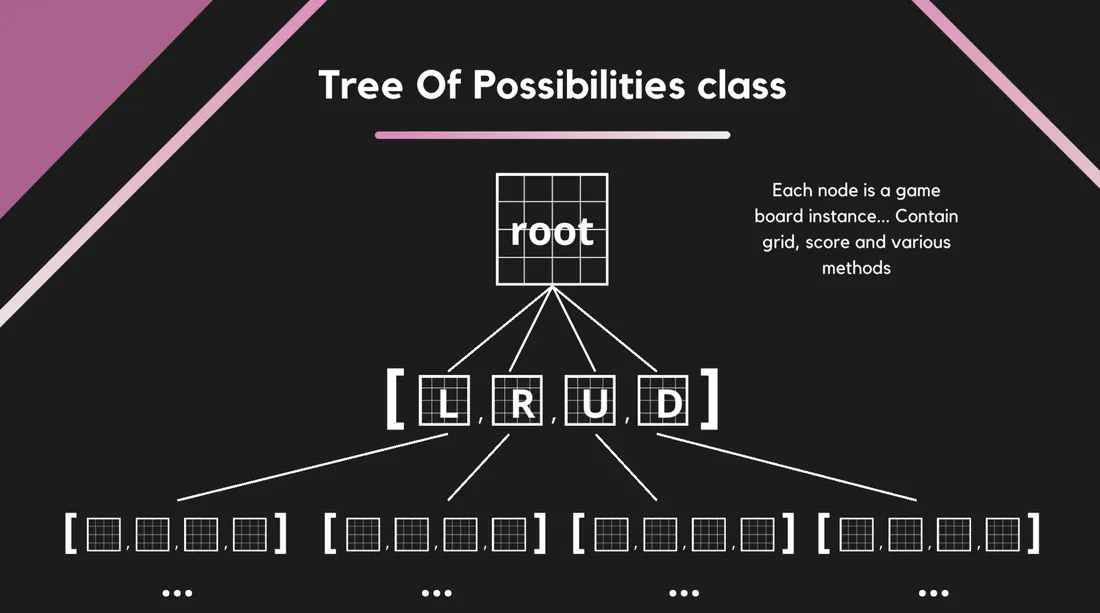
Presentation slide explaining the move and quicksort algorithms behind the 2048 implementation.

Side project

2048, as an algorithms problem

Built to study the move logic, data structures and sorting behind the game rather than the game itself.

Side project

Live translator

Speech recognition to translation to speech, so two people without a shared language can hold a conversation.

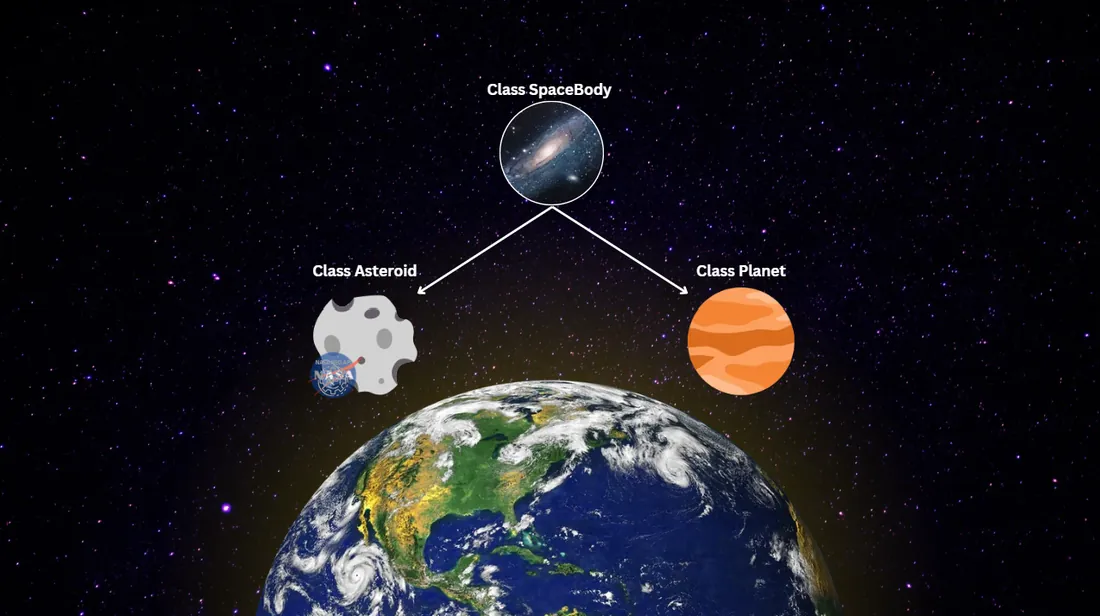
The Near-Earth Object Analyzer interface, listing asteroids returned from NASA's database for a chosen date range.

Team project · C++ course

Near-Earth Object Analyzer

Queries NASA's Near-Earth Object database for a date range and analyses the asteroids it returns, objects whose trajectory brings them within roughly 45 million km of Earth. Built in C++ with my course team.

Side project

Automatic bin

Senses approaching hands with trash and opens itself. A sensor, an actuator and a state machine. My first robot!

Experience

Aug 2023 - presentMadrid, Spain

Research Assistant

CyPhy Life, IE Robotics and AI Lab

  • Built AIfred and ran its 36-participant study; first author on the ICRA 2027 submission.
  • Co-develop Botzo: inverse kinematics, gait planning, leg & body design, IMU stabilisation, ROS integration, and now RL locomotion in Isaac Lab.
  • Lab 3D printing lead; ongoing ROS 1 work across the lab's other systems.

Jul - Dec 2025Luxembourg

Research Assistant

University of Luxembourg, SnT, Automation & Robotics Group

  • Contributed to a PhD project on mixed reality and human-robot interaction, connecting SLAM output to Unity.
  • Built PolyWall: dense LiDAR SLAM maps into lightweight polygonal walls.
  • Research poster: From Point Clouds to Polygonal Walls published to VR Summit 2026.

Jan - May 2024Madrid, Spain

Software Team Member

Formula Student, UC3M Team

A ROS 2 package in C++ recording every message on the car to a ROS bag and spreadsheet, for post-run performance analysis.

Education

2022 - 2026
BSc Computer Science & Artificial Intelligence, IE University (GPA 8.56/10)
Coursework
Algorithms & Data Structures · AI & Machine Learning · Reinforcement Learning · Computer Vision · Introduction to Robotics · Linear Transformations · HPC · C++

Also trained in

ROS
“ROS 2 Basics in Python” and “RL in ROS” (The Construct)
Motion capture
OptiTrack training with Target 3D specialists (2024)
ML
Coursera AI course with Andrew Ng (2020)

Technical skills

Robotics middleware

  • ROS 1: AIfred, theconstructsim.com online course, WX250s Trossen Robotics,
  • ROS 2: Botzo, Polywall, S-Graphs, Formula Student
  • rosbag, launch files, TF frames
  • URDF modelling, Gazebo, Rviz

Programming

  • Python
  • C, C++
  • Arduino, Raspberry Pi, embedded control
  • Linux (Ubuntu, Raspberry Pi OS)
  • Git & GitHub

Simulation & learning

  • NVIDIA Isaac Sim, Isaac Lab, PyBullet
  • RL for locomotion (in progress)
  • Inverse kinematics & gait planning

Perception & vision

  • Camera-based workspace perception
  • Image processing pipelines (Python)
  • Face / eye detection (MediaPipe, Haar)
  • LiDAR point clouds & SLAM maps
  • OptiTrack motion capture

Hardware & CAD

  • Fusion 360
  • 3D printing (lab lead)
  • Servos, IMUs, motor drivers
  • Battery & voltage regulation
  • Arduino, ESP32, Raspberry Pi

XR & research methods

  • Unity & HoloLens 2
  • Polygonal map representation
  • Experimental design & Qualtrics
  • pandas, SciPy, Pingouin
  • Technical writing & posters